Deskripsi Proyek & Solusi
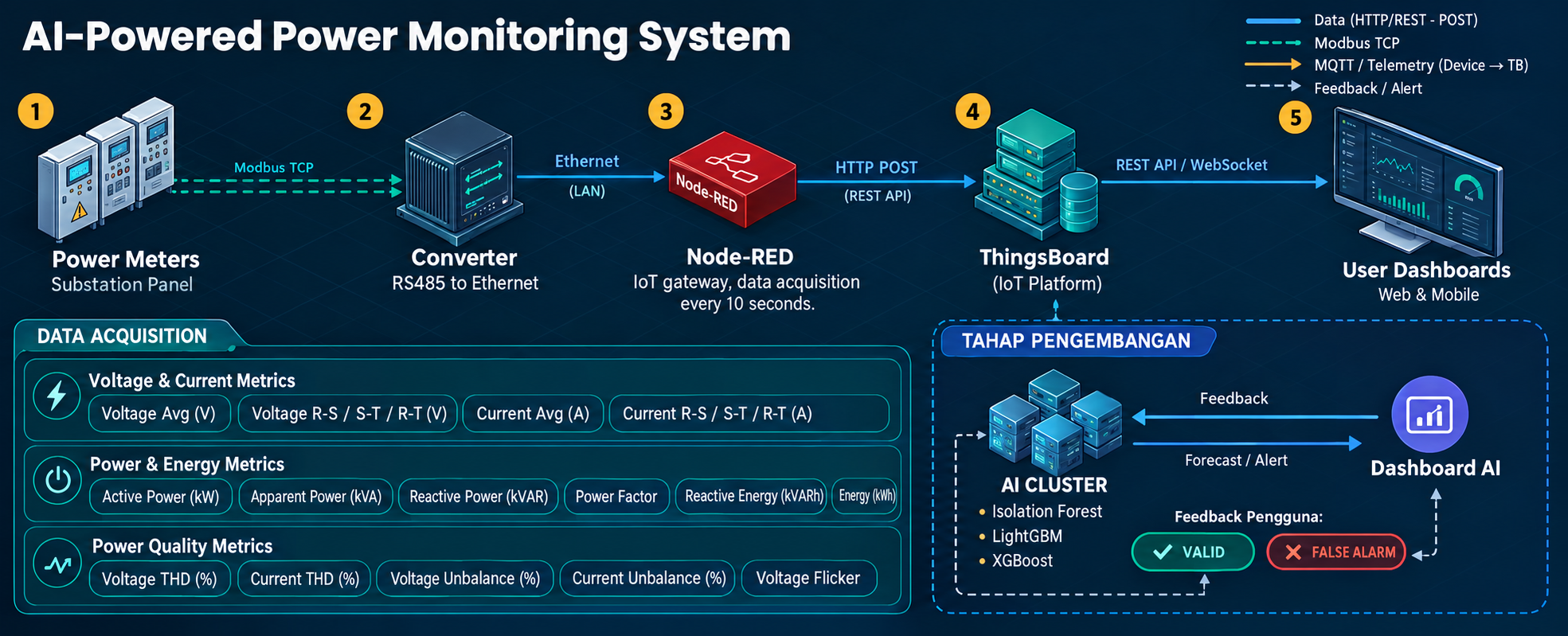
Digitalization of factory electrical monitoring through the integration of power meters across multiple substations into a centralized dashboard. The system provides real-time electrical monitoring and historical energy consumption data, serving as the foundation for AI-powered analytics, including anomaly detection and electrical load forecasting.
The system is currently under development, with ongoing improvements driven by user feedback and operational requirements.
Project Overview
Electricity is a critical utility in factory operations. Continuous electrical monitoring is essential for understanding energy consumption patterns, identifying potential abnormalities, and supporting operational reliability. This project integrates power meter data from multiple areas and substations into a centralized monitoring platform, providing users with a unified view of the factory's electrical conditions.
System Architecture & Data Acquisition
The system acquires data from power meters via Modbus RTU communication, with data transmitted through Ethernet converters. Node-RED serves as the IoT gateway, collecting and forwarding the data to ThingsBoard at a 10-second acquisition and storage interval. Historical data has been collected since June 1, 2025.
Monitored parameters include voltage, current, active and apparent power, power factor, energy consumption, and power quality indicators. The dashboard can also display other electrical parameters supported by the connected power meters and the configured data acquisition system.

Monitoring Dashboard
The ThingsBoard dashboard provides visibility into electrical conditions through real-time measurements, trend charts, alarm panels, and historical data. Users can monitor the electrical conditions of individual substations through a single interface without having to inspect electrical panels directly.

Historical data also enables users to investigate load variations and energy consumption patterns over time, supporting more informed operational analysis and decision-making.
AI-Powered Energy Analytics - In Progress
The system is currently under development, with the next phase focused on expanding the monitoring platform into an AI-powered predictive analytics solution. This development is ongoing and requires user feedback and operational validation to ensure that the resulting features align with actual plant requirements.
The historical dataset, collected at 10-second intervals, provides a foundation for the following development initiatives:
1. Anomaly Detection
Developing capabilities to identify electrical patterns that deviate from normal operating conditions using machine learning approaches such as Isolation Forest and Random Forest. Further development will focus on validating detection results against actual operating conditions and user feedback.
2. Load Forecasting
Developing predictive models to estimate future electrical loads and energy consumption trends using time-series forecasting and machine learning techniques, such as LightGBM and XGBoost. Model performance and practical usefulness will be evaluated as development progresses.
3. Power Quality Analysis
Developing analytical capabilities to identify potential voltage imbalances, elevated harmonic distortion, and low power factor based on available electrical parameters and relevant operating thresholds. The analysis will be refined according to equipment capabilities, data availability, and user-defined operational requirements.
4. Feedback-Driven Improvement
Implementing a user feedback and alarm validation mechanism to assess detection results, identify false positives, and progressively improve alert accuracy and system reliability. User input will play an important role in defining normal operating conditions, prioritizing relevant alarms, and refining analytical features.
The ongoing development aims to evolve the platform beyond electrical monitoring into a data-driven decision support system that helps users identify potential issues earlier, understand electrical operating patterns, and improve energy management. Development priorities and feature enhancements will be refined iteratively based on user feedback, validation results, and operational needs.