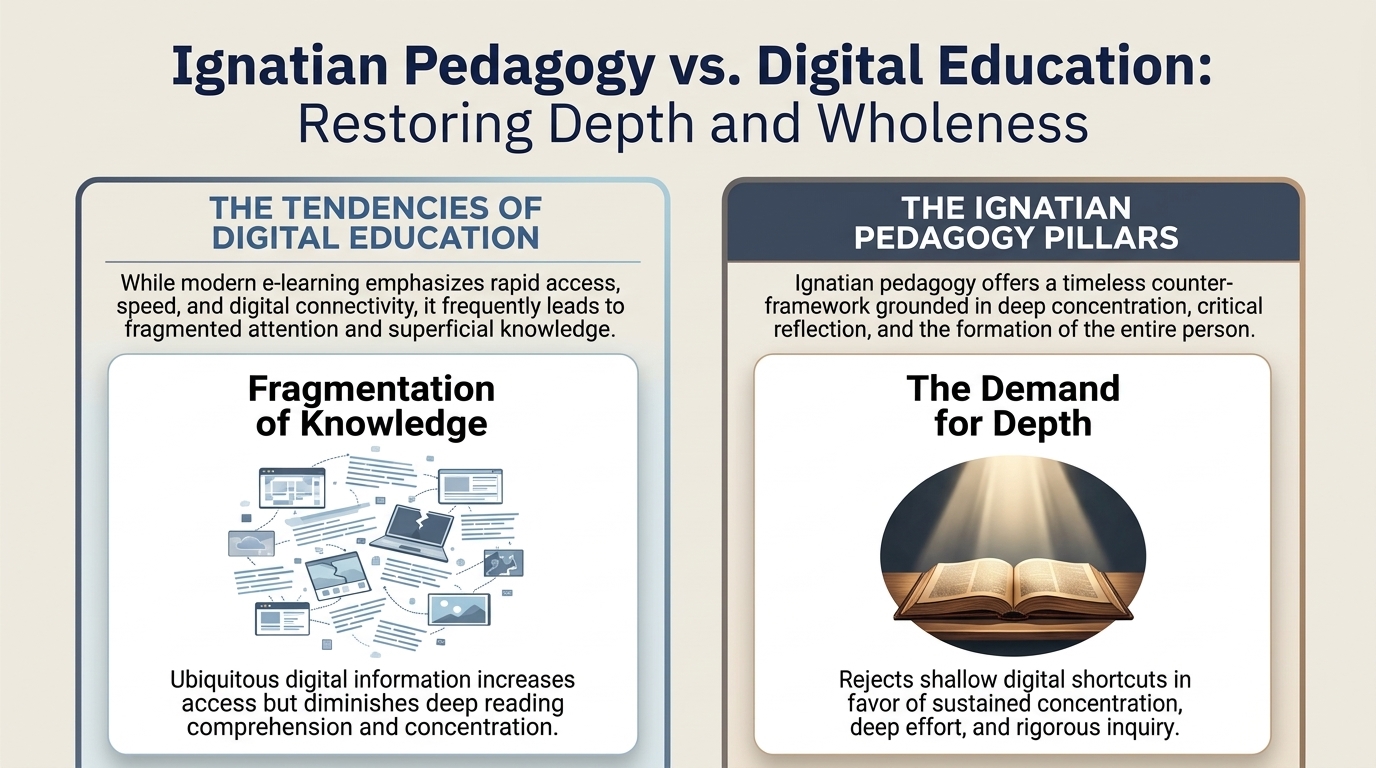
Deskripsi Proyek & Solusi
Portofolio berikut menggambarkan ketegangan antara modern digital education dengan pedagogi berdasarkan nilai-nilai Ignatian yang menghargai kedalaman, karakter, dan relasi antar manusia. Portofolio ini mengambil poin-poin utama dari Nemec (2021) mengenai kehadiran, pedagogi, multimodalitas berfokus pada bagaimana nilai-nilai pendidikan tradisional melawan pendangkalan dalam lingkungan pembelajaran digital modern.
The provided text examines the tension between modern digital education and traditional Ignatian pedagogy. While the digital era offers rapid access to information and promotes technological integration, it simultaneously fosters superficiality, fragmented thinking, and diminished reading comprehension. To counter these modern distractions, the author advocates for deep concentration and the complete, integral development of the individual. Drawing on historical Jesuit principles and the insights of leaders like Pedro Arrupe and Adolfo Nicolás, the source emphasizes nurturing students through meaningful interpersonal relationships and robust intellectual discipline. Ultimately, the article argues that the timeless values of Ignatian education remain vital for helping students navigate and resist the shallow tendencies of contemporary digital culture.
Langkah-langkah pembuatan portofolio How Digital Minimalism creates Deep Work:
- Membuka Notebook LM dan membuka fitur create Note.

- Setelah muncul Untitled Notebook, lalu mengunggah artikel dari Nemec (2021) dengan mengunggah pada fitur add source.

- Mengajukan prompt berupa pertanyaan What are the key points from this article related on the topics of presence, embodiment, Ignatian pedagogy, and multimodality? Apa poin utama dari artikel tersebut dengan topik kehadiran, embodiment, pedagogy dan multimodality?

- Lalu setelah muncul jawaban kemudian klik Studio dan video overview dan generate Now.

The key points from Nemec (2021) regarding Ignatian pedagogy, presence, embodiment, and multimodality focus on how traditional Jesuit educational values counter the superficiality of modern digital learning environments.
1. Ignatian Pedagogy
2. Presence
3. Embodiment
4. Coverage of Multimodality
💡 If you'd like, we could frame these core principles into a comparative matrix contrasting digital learning trends with Ignatian pedagogical depth to help structure a discussion or presentation.
Translate to Indonesian
Thoughts
Berikut adalah terjemahan dari poin-poin utama tersebut ke dalam bahasa Indonesia:
Poin-poin utama dari Nemec (2021) mengenai pedagogi Ignasian, kehadiran (presence), penubuhan (embodiment), dan multimodalitas (multimodality) berfokus pada bagaimana nilai-nilai pendidikan Yesuit tradisional melawan pendangkalan dalam lingkungan pembelajaran digital modern.
1. Pedagogi Ignasian
2. Kehadiran (Presence)
3. Penubuhan (Embodiment)
4. Cakupan tentang Multimodalitas (Multimodality)
RESEARCH OBJECTIVE: The aim of this study is to present some contradictory tendencies and draw attention to two phenomena that prove their contradiction. The first one is the missing dimension of depth of knowledge which suggests that the ubiquitous source of information and student awareness is not automatically a qualitative asset. On the other hand, the gradual digitalization of education increasingly indicates the fragmentation of such a teaching process. THE RESEARCH PROBLEM AND METHODS: The article intends to emphasize the importance of two pillars of Jesuit pedagogy, which historically date back to the Spiritual Exercises of St. Ignatius and which were revived by the interpretations of two former superiors of the Society of Jesus, P. Arrupe and A. Nicholas. However, the present times seems to bring different goals in the perspective of digital media and professional profiling of the student. THE PROCESS OF ARGUMENTATION: The article is structured as follows. In the first part, the author presents the conclusions resulting from some research and measurements conducted in Slovakia in recent years, which aimed at examining students' skills in reading comprehension and indicates the growing support for the digitalisation of education in Slovakia, which the author (and not only he) perceives as highly contradictory. On the other hand, the article makes an attempt to counter the notions: the "reference to depth" and the integrity of the human being, more and more often mentioned in the literature. Through this call for "digital minimalism" it encourages deeper concentration. RESEARCH RESULTS: The present study is to demonstrate that Jesuit pedagogical appeal to the need for "integral" development of the person and "depth" is extremely actual in this field. CONCLUSIONS, INNOVATIONS, RECOMMENDATIONS: The aim of the study is to show the need to re-develop these threads of depth and integral development of the human being, along with other pillars of Jesuit education, and rethink its message.
The Internet offers new, faster ways of learning and processing information. The access to information is becoming easier and more popular, so an increasing number of users reach for it. It was also taken into account in the UNESCO declaration on education, in which one of the most urgent educational objectives for the coming years is "providing schools with digital technologies, digitalization of educational resources, as well as The Idea of "Depth" in Ignatian Pedagogy 71 introduction of e-learning platforms that overcome the limitations of traditional teaching and promise connectivity" (UNESCO, n.d. - declaration on digital, personalized and lifelong learning to facilitate open, appropriate, people-centered, sustainable and equitable approaches to education). In a more global perspective, this is a revolutionary idea connected with collective intelligence and higher scholarship standards which, due to the digital revolution, "translates all possible and imaginable documents into a virtual, interconnected and omnipresent space" (Fišerová, 2015, p. 134). The scope of knowledge which is, in this way, available both for the teacher and student, becomes the basis for incredible creativity and a broad fundament of a potential to be used in practice, in the process of education. Apart from the general appearance of digitalization and electronic media, science makes other progress. Within the last two years, the media announced that scientists invented a new kind of writing which radically changes the old, established alphabetical writing. In their opinion, due to this invention we will be able to read and learn faster. This new font is called Sans Forgetica, and it was invented in the Royal Melbourne Institute of Technology (RMIT). The font works through a brain training and uses its possibilities in the areas, in which it was neglected. It means that the scientists removed parts of particular letters, which unnecessarily "hold" an eye and brain while reading, and which can be freely completed by the brain (Porubský, 2018). This kind of "fast reading" and "fast learning" is symptomatic for our times. Fast thinking and decision-making replace established norms in pedagogy and education. Thus, the ability to acquire information quickly is not "hindered" by the redundant number of letters (vowels). Therefore, can we rightly ask if the common denominator and the only criterion of effective learning is the accessibility and speed of receiving and processing information? Apparently, in Slovakia (but not only here) we are witnessing two contradictory tendencies. One of them is the general digitalization of education, which aims at developing students' computer skills and including IT technologies into the process of education, as this will increase learning opportunities and make the educational process more interesting. The objective of such digitalization is the opportunity to become "practically" involved in the process of education, also in a more active and creative manner. On the other hand, this general tendency for digitalization has some disturbing consequences in the form of the lack of concentration and worse results in reading comprehension. This may result from the fact that digital media are included in the process of education which does not fully support the "depth" of learning and distracts students' attention.
For Cal Newport it is important to realize that the phenomenon of the future will not only be the acquisition of the ability to count and use a computer, but a "deep" attitude - the depth of science and work, as well as the ability to focus on a particular action combined with an untiring search for a solution. Newport believes that deep concentration is now in a very unfavourable situation due to today's era of the Internet. Deep concentration is based on quality, slow and honest approach, while the Internet offers "easier" and "faster" solutions, "drawing students away" from their work. Promoting deep concentration, in turn, requires the rejection of many modern IT technologies (Newport, 2016, p. 42). This idea is also supported by some psychologists who claim that what gives meaning to the learner are activities related to deep concentration as they provide the student with intensive experience. For example, Mihaly Csikszentmihalyi is a psychologist who says that when we concentrate on an activity, we experience greater intensity than when we do nothing (Csikszentmihályi, 1996, pp. 13-14). Comparing to the classical models which analyse the sense of happiness, the author does not claim that a person is happy when he/she does not do anything. He presented a thesis that is contradictory to the previous statements. While working and "struggling" with a problem, we feel greater intensity than while choosing an easier way - a day off, relax or inactivity. M. Csikszentmihalyi calls this concept a theory of "flow." The opinions of both of those authors lead to one conclusion: digital technologies and the digital era force us to act faster. With the kinds of impulses it offers, it places us among many tasks at the same time - while focusing on many things, we are unable to perform them in a "deep" manner. Ignatian pedagogy based on two principles: depth and a person's integrity O'Malley separated elements (O'Malley, 1993, 279-280) which contributed to the original and further success of the Jesuits, and to the creation of a new and international pedagogical style. Here are two of those elements that I would like to emphasize: 1. Jesuits provided more responsible education and they were better motivated than most teachers in schools that functioned before the universities in Europe. Also, Jesuits tried to influence students with their life rather than with words. The Idea of "Depth" in I
They had a different approach and they treated a student as a whole. In this sense, Jesuits cared for the development of the whole personality and not just for one of its aspect. 2. Such approach was connected with humanism in the Jesuit pedagogy. Humanism is derived from the interest in a human being, and such interest has practical implications in the pedagogical context. Contrary to university education, studia humanitatis cared for "ethical, spiritual, religious, emotional, as well as physical development of students." A human being, as one of the key subjects of humanism, eventually becomes an integral part of Ignatian spirituality, which perceives a person's dignity through the Christological context of the Incarnation. At the same time, such spirituality perceives a human being in the context of the sanctity of the relationship of love which God maintains with His creation (Ignác z Loyoly, 2005, pp. 30-31) and to which a person only responds at the moment (Jeník, 2015, pp. 13-14). Jesuits always emphasized the importance of love for their students, individual knowledge of them, as well as relationships based on respect for them. Such a "deep" relationship at the beginning makes it possible to transfer this "depth" for later. Apart from those historical circumstances, it is worth thinking about the recent interpretation which is always suggested by the superiors of the Society of Jesus, e.g. Pedro Arrupe (†1991). Ignatian pedagogical paradigm of a person's integrity This paradigm will be presented here as an attitude which is generally called the "Ignatian pedagogical paradigm." It is an approach to teaching and learning which St Ignatius outlines in his Spiritual Exercises (Ignác z Loyoly, 2005, pp. 31). Just like the objective of the Spiritual Exercises is to support one in an active response to the Lord's call in prayer, the objective of the Ignatian pedagogical paradigm is to enable the student to develop the mind's habits and creative answers. According to P.Arrupe, this paradigm may create a strong culture of education in our schools. Such culture can, to a certain degree, balance the influence of the individualistic consumer culture on young people. Arrupe admits that a human being "with his/her conscience, intelligence and abilities, is truly in the centre" of education (Arrupe 1980, p. 134). What is important, however, is that a person is "a centre called to come out of themselves (exsistere), to give themselves to others in love which is their ultimate and overwhelming dimension as it gives meaning to all their other dimensions" (Arrupe 1980, p. 134). Relationships among people are the basis for the development of a person as a whole - in all his/her aspects - in the environment which is a palette of relationships. A relationship is at the beginning of human life and at the end of it. A person is born into relationships, which results in the fact that in education it is important to continue a whole
person's development in relationships. This will make it possible to develop a person as a whole - not as particular parts separately (separately intellectual and psychological, separately spiritual, separately the emotional part, etc.), but all the parts at the same time. Relationships constitute the whole personality, moving it forward towards maturity. That is why, it is important for a student to identify himself/herself based on those relationships and to confront with them (also with his/her spiritual and psychological attitudes and behaviour), what can facilitate their development and growth. Jacob A. O'Donnell quotes P. Arrupe, saying that Jesuit education is focused on the student. Its objective is the creation of an independent and responsible student who is skilful, able to function independently, and willing to take up various actions in a responsible manner (Arrupe, 1981b, p. 470). P. Arrupe also explains that "the objective of our schools is not educating little academic monsters who are dehumanized and introvert. We do not want to raise pious bigots who are indifferent to the world in which they live and unable to take responsibility for it". Instead, the objective of education is to form people who are "calm, cheerful and persistent, and open to everything that is human" (Arrupe, 1981b, p. 64). It means that human values, which are to be instilled in the students, i.e. "academy, Gospel, service, openness, sensitivity to the present and the future," are to be "mixed in a balanced manner," form reasonable people (Arrupe, 1981b, p. 64). Simply speaking, this is a formation of a "whole person" (Arrupe, 1981b, p. 77) in the "intellectual, artistic, moral, and religious sense" (Arrupe, 1981a, p. 87).